Seorang Yang Mempunyai Mimpi-mimpi Besar Tentang Pengembangan Kreatif Marketing Untuk Perusahaan Anda Andi Riawan Krisdianto.Com
Profesional Creative Marketing, Bussines Auditor, Elektrik & Komputer Maintenance, Control panel, Pengadaan barang
Hasil yang di capai adalah tergantung bagaimana cara kita memperjuangkan sampai keringat darah terakhir sekalipun, semangat dan terus semangatlah jangan biarkan kita hidup dan mati tanpa kesuksesan apapun

~~~~~~~~~~~~~~~~~~~~~~~~~~~~~~~~~~~~~~~~~~~~~~~~~~~~~~~

sedekah mendatangkan banyak keuntungan dan barokah

No rekening donasi dan sedekah : BCA 0960663675 , BRI 0004 01 030993 50 0

Selasa, 24 Mei 2011

4 Prinsip Dasar untuk Komunikasi Produktif

Komunikasi saya kira merupakan salah satu bagian yang paling esensial dalam roda kehidupan profesional kita. Kita menyaksikan begitu banyak projek atau program perusahaan macet ditengah jalan hanya gara-gara dis-komunikasi para anggotanya. Sebaliknya, kita juga bisa menyaksikan sebuah arena lingkungan kantor yang bisa berjalan dengan indah lantaran didalamnya terbangun proses komunikasi yang elegan nan produktif.

Sejatinya ketrampilan komunikasi yang efektif memang merupakan sebuah elemen yang patut dijiwai oleh setiap pelaku bisnis dan kaum profesional – entah mereka berperan sebagai manajer, staf pelaksana ataupun para business owner. Berikut ini kita akan mencoba menelisik empat prinsip dasar yang mungkin mesti selalu kita ingat manakala kita ingin menjadi seorang komunikator yang produktif.

Prinsip # 1 : Fokus pada solusi, bukan pada masalah. Ketika kita berinteraksi di kantor, acap kita menyaksikan orang saling sibuk berbicara mencari kambing hitam, menyalahkan pihak lain, dan melulu berfokus pada masalah. Bagian produksi menyalahkan orang marketing. Bagian marketing menyalahkan orang Finance. Dan bagian HRD menjadi tempat tumpahan kekesalan semua departemen (capek deh).

Alih-alih berfokus melulu pada masalah dan sibuk mencari siapa kambing hitamnya, komunikasi kita akan jauh lebih produktif jika kita fokus pada solusi. Sebagai misal, jika kita menemui hambatan dalam salah satu program kerja yang dijalankan di kantor, maka segera kita mesti berdiskusi mencari jalan keluar untuk mengatasi hambatan itu. Otak kita mesti kita gedor untuk segera bicara mengenai solusi, dan menutup pintu bagi munculnya kata-kata yang menyalahkan pihak lain.

Mencari-cari kesalahan dan meyalahkan pihak lain memang mudah, dan secara intuitif, banyak orang yang menyukainya (!) Namun ini hanya buang waktu, dan itulah mengapa banyak kinerja perusahaan macet ditengah jalan. Lipatlah kebiasaan ini dan simpan rapat-rapat didalam laci. Kelak jika Anda menemui rintangan, munculkan sikap yang FOKUS pada SOLUSI.

Prinsip # 2 : Ganti kata-kata Tidak Bisa menjadi Bisa. Contoh sederhana : “Pak, kita TIDAK bisa menyelesaikan projek ini tanpa dukungan tim logistik yang handal”. Kalimat ini akan menjadi lebih produktif dan meletupkan optimisme jika kita ganti menjadi : “Pak kita bisa menyelesaikan projek ini dengan dukungan yang bagus dari tim logistik”. Atau contoh simpel lainnya : “Nak, kamu tidak akan naik kelas jika tidak belajar tekun”. Kalimat ini akan menjadi lebih elegan kalau kita ubah menjadi : “Nak, kamu pasti akan naik kelas jika rajin belajar”.

Para pakar psikologi bilang, semakin banyak kata “tidak” dan kata negatif lainnya kita ucapkan, secara tidak sadar hal ini akan mendorong perilaku kita ke arah negatif (tidak bisa, tidak mampu, dst). Sebaliknya, dengan framing kalimat yang positif, dan ini dilakukan secara repititif, akan membuat perilaku kita menjadi lebih optimis dan kian produktif.

Itulah mengapa ada sebuah nasehat yang mengharapkan agar setiap kosa kata yang mengandung makna negatif (seperti kata : tidak bisa, gagal, tidak mampu, tidak berpengalaman, tidak kompeten, dll) sebaiknya dienyahkan dari perbendaharaan komunikasi kita sehari-hari.

Prinsip # 3 : Katakan apa yang anda inginkan, bukan apa yang tidak anda inginkan. Prinsip ini mirip dengan prinsip nomer dua diatas. Yakni mengajarkan kepada kita untuk selalu membuat frame kalimat positif ketika ingin menyampaikan pesan. Sebagai misal, daripada mengatakan : “Mas, kalau nyetir mobil jangan kebut-kebut” lebih baik disampaikan dengan kalimat : “Mas, nyetir mobilnya hati-hati ya”. Atau contoh lain : “Kalau bikin laporan jangan ceroboh dan banyak bikin kesalahan”. Mengapa kita tidak menggantinya menjadi : “Kalau bikin laporan, tolong konsentrasi penuh agar semua data tersaji dengan akurat”.

Prinsip # 4 : Fokus ke depan, bukan ke masa lalu. Dalam lingkungan pergaulan di kantor kita acap mendengar kalimat seperti : “Nah, apa gue bilang kan……”. Atau kalimat seperti ini : “Nah, bener kan apa yang gue sampekan…”. Oke, kalimat-kalimat seperti ini memang membuat yang ngomong merasa “hebat”, but so what? Jadi, daripada fokus pada masa lalu sebaiknya kita ucapkan : “Okay, kita ambil hikmahnya. Mulai sekarang dan ke depan, kita harus lebih…..”. Kalimat ini akan membuat mitra bicara kita menjadi lebih mendapat respek. Kalimat itu juga akan membuat kita lebih bisa fokus pada solusi, dan maju ke arah masa depan yang lebih baik.

Demikianlah empat prinsip dasar komunikasi yang efektif. Semuanya sejatinya bersifat simpel, sederhana dan praktikal. Namun memang acap kita lupa untuk mempraktekkannya, dan dimana-mana kita banyak melihat orang mengabaikannya.

Karena itu, tak ada salahnya jika poin-poin kunci dalam tulisan ini Anda print lalu tempelkan didekat meja kerja Anda. Siapa tahu dengan itu, Anda bisa menjadi insan yang lebih produktif dalam membangun komunikasi?


andi riawan krisdianto
Marketing Research

Marketing Research is " the function that links the consumer, customer, and public to the marketer through information — information used to identify and define marketing opportunities and problems; generate, refine, and evaluate marketing actions; monitor marketing performance; and improve understanding of marketing as a process. Marketing research specifies the information required to address these issues, designs the method for collecting information, manages and implements the data collection process, analyzes the results, and communicates the findings and their implications."Marketing research is the systematic gathering, recording, and analysis of data about issues relating to marketing products and services. The goal of marketing research is to identify and assess how changing elements of the marketing mix impacts customer behavior. The term is commonly interchanged with market research; however, expert practitioners may wish to draw a distinction, in that market research is concerned specifically with markets, while marketing research is concerned specifically about marketing processes.

Marketing research is often partitioned into two sets of categorical pairs, either by target market:

  • Consumer marketing research, and
  • Business-to-business (B2B) marketing research

Or, alternatively, by methodological approach:

  • Qualitative marketing research, and
  • Quantitative marketing research

Consumer marketing research is a form of applied sociology that concentrates on understanding the preferences, attitudes, and behaviors of consumers in a market-based economy, and it aims to understand the effects and comparative success of marketing campaigns. The field of consumer marketing research as a statistical science was pioneered by Arthur Nielsen with the founding of the ACNielsen Company in 1923.

Thus, marketing research may also be described as the systematic and objective identification, collection, analysis, and dissemination of information for the purpose of assisting management in decision making related to the identification and solution of problems and opportunities in marketing.


andi riawan krisdianto

Senin, 23 Mei 2011

Marketing Mix

What is the marketing mix?

The marketing mix is probably the most famous marketing term. Its elements are the basic, tactical components of a marketing plan. Also known as the Four P's, the marketing mix elements are price, place, product, and promotion. Read on for more details on the marketing mix.

The concept is simple. Think about another common mix - a cake mix. All cakes contain eggs, milk, flour, and sugar. However, you can alter the final cake by altering the amounts of mix elements contained in it. So for a sweet cake add more sugar!

It is the same with the marketing mix. The offer you make to you customer can be altered by varying the mix elements. So for a high profile brand, increase the focus on promotion and desensitize the weight given to price. Another way to think about the marketing mix is to use the image of an artist's palette. The marketer mixes the prime colours (mix elements) in different quantities to deliver a particular final colour. Every hand painted picture is original in some way, as is every marketing mix. If you'd like to see the marketing mix applied to a real business - then take a look at our .


andi riawan krisdianto

metode swot

Analisis SWOT adalah metode perencanaan strategis yang digunakan untuk mengevaluasi kekuatan (strengths), kelemahan (weaknesses), peluang (opportunities), dan ancaman (threats) dalam suatu proyek atau suatu spekulasi bisnis. Keempat faktor itulah yang membentuk akronim SWOT (strengths, weaknesses, opportunities, dan threats). Proses ini melibatkan penentuan tujuan yang spesifik dari spekulasi bisnis atau proyek dan mengidentifikasi faktor internal dan eksternal yang mendukung dan yang tidak dalam mencapai tujuan tersebut. Analisa SWOT dapat diterapkan dengan cara menganalisis dan memilah berbagai hal yang mempengaruhi keempat faktornya, kemudian menerapkannya dalam gambar matrik SWOT, dimana aplikasinya adalah bagaimana kekuatan (strengths) mampu mengambil keuntungan (advantage) dari peluang (opportunities) yang ada, bagaimana cara mengatasi kelemahan (weaknesses) yang mencegah keuntungan (advantage) dari peluang (opportunities)yang ada, selanjutnya bagaimana kekuatan (strengths) mampu menghadapi ancaman (threats) yang ada, dan terakhir adalah bagimana cara mengatasi kelemahan (weaknesses) yang mampu membuat ancaman (threats) menjadi nyata atau menciptakan sebuah ancaman baru.


Teknik ini dibuat oleh Albert Humphrey, yang memimpin proyek riset pada Universitas Stanford pada dasawarsa 1960-an dan 1970-an dengan menggunakan data dari perusahaan-perusahaan Fortune 500.


andi riawan krisdianto

Marketing Manajemen

Marketing Management is a business discipline which is focused on the practical application of marketing techniques and the management of a firm's marketing resources and activities. Rapidly emerging forces of globalization have compelled firms to market beyond the borders of their home country making International marketing highly significant and an integral part of a firm's marketing strategy. Marketing managers are often responsible for influencing the level, timing, and composition of customer demand accepted definition of the term. In part, this is because the role of a marketing manager can vary significantly based on a business' size, corporate culture, and industry context. For example, in a large consumer products company, the marketing manager may act as the overall general manager of his or her assigned product To create an effective, cost-efficient Marketing management strategy, firms must possess a detailed, objective understanding of their own business and the market in which they operate. In analyzing these issues, the discipline of marketing management often overlaps with the related discipline of strategic planning.

andi riawan krisdianto

Customer

A customer (also known as a client, buyer, or purchaser) is usually used to refer to a current or potential buyer or user of the products of an individual or organization, called the supplier, seller, or vendor. This is typically through purchasing or renting goods or services. However, in certain contexts, the term customer also includes by extension any entity that uses or experiences the services of another. A customer may also be a viewer of the product or service that is being sold despite deciding not to buy them. The general distinction between a customer and a client is that a customer purchases products, whereas a client purchases services.

The word derives from "custom," meaning "habit"; a customer was someone who frequented a particular shop, who made it a habit to purchase goods of the sort the shop sold there rather than elsewhere, and with whom the shopkeeper had to maintain a relationship to keep his or her "custom," meaning expected purchases in the future.

The slogans "the customer is king" or "the customer is god" or "the customer is always right" indicate the importance of customers to businesses – although the last expression is sometimes used ironically.

However, "customer" also has a more generalized meaning as in customer service and a less commercialized meaning in not-for-profit areas. To avoid unwanted implications in some areas such as government services, community services, and education, the term "customer" is sometimes substituted by words such as "constituent" or "stakeholder". This is done to address concerns that the word "customer" implies a narrowly commercial relationship involving the purchase of products and services. However, some managers in this environment, in which the emphasis is on being helpful to the people one is dealing with rather than on commercial sales, comfortably use the word "customer" to both internal and external customers.

OBSOLETE meaning: In the early 17th century customer was defined as a "common prostitute". This meaning is important for understanding historical literary works. ("I marry her! What, a customer?")Othello, or ("I think thee now a common customer") All's Well that Ends Well.Today the meaning of "customer" has been inverted in this usage.


andi riawan krisdianto

Marketing is "the activity, set of institutions, and processes for creating, communicating, delivering, and exchanging offerings that have value for customers, clients, partners, and society at large."Marketing is a product or service selling related overall activities. It generates the strategy that underlies sales techniques, business communication, and business developments It is an integrated process through which companies build strong customer relationships and create value for their customers and for themselves.

Marketing is used to identify the customer, satisfy the customer, and keep the customer. With the customer as the focus of its activities, it can be concluded that marketing management is one of the major components of business management. Marketing evolved to meet the stasis in developing new markets caused by mature markets and overcapacities in the last 2-3 centuries.The adoption of marketing strategies requires businesses to shift their focus from production to the perceived needs and wants of their customers as the means of staying profitable.

The term marketing concept holds that achieving organizational goals depends on knowing the needs and wants of target markets and delivering the desired satisfactions. It proposes that in order to satisfy its organizational objectives, an organization should anticipate the needs and wants of consumers and satisfy these more effectively than competitors

andi riawan krisdianto

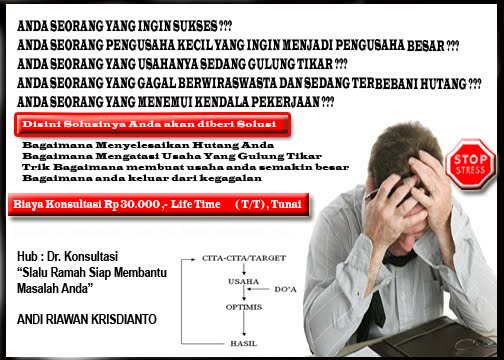
Dokter Masalah Keuangan & Kehidupan Anda

Dokter Masalah Keuangan & Kehidupan Anda
Silahkan Transfer Biaya Konsultasi Sebagai Donasi Pengembangan Dr. Solusi

Semangat Baru KITA HARUS BERUBAH, KITA BISA

Semangat Baru KITA HARUS BERUBAH, KITA BISA
Faith makes all things possible.Hope makes all things work. Love makes all things beautiful. May you have all of the three.

 
Design by Free WordPress Themes | Bloggerized by Lasantha - Premium Blogger Themes | Elf Coupons